Manhattan

212-265-0110

White Plains

914-227-2305

Springfield, NJ

973-315-7830

Hauppauge

631-265-3136
Categories
Headaches Jaw Problems Nightguards & Oral Appliances Orofacial Pain TMJ

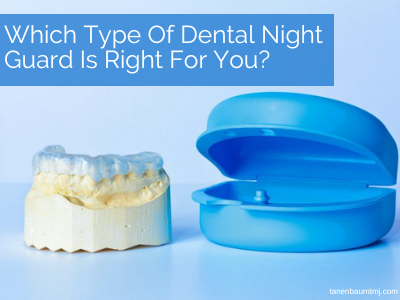
Which Type Of Dental Night Guard Is Right For You?

As an orofacial pain specialist, patients come to me when they’re suffering from the painful symptoms of a temporomandibular disorder, which you may know as TMJ. TMJ refers to the temporomandibular joint, the joint that enables you to open and close your mouth. Many new patients who come to my office have been wearing a standard dental night guard (sometimes called an oral appliance, occlusal splint, or mouth guard) while they sleep, but their symptoms are not improving or even getting worse. Before I explain which type of dental night guard is right for you, I want to make sure you understand TMJ and its causes.

First, What Causes TMJ?

Symptoms of jaw (TMJ) problems often arise due to sleep bruxism, a condition characterized by constantly grinding or clenching your teeth during sleep. Sleep bruxism affects about 10% of adults and up to 15% of children.

The American Dental Association has been surveying dentists about TMJ since the beginning of the pandemic. More than 70% report a significant increase of patients who are grinding and clenching their teeth both during sleep and while awake (called awake bruxism) – many of whom never had the issue before. Some patients even have cracked or broken teeth as a result of bruxing. Bruxism is thought to be related to several risk factors, including high-stress levels – so it comes as no surprise that this increase coincides with the pandemic.

How To Determine Which Type of Dental Night Guard Is Right For You

If you’re like many people, your dentist may have informed you that your teeth are becoming flat and worn-down because of grinding and clenching while you’re asleep. Your dentist may have recommended you start wearing a dental night guard while you sleep, or you may have already purchased one over-the-counter at your pharmacy.

If this sounds familiar, the standard type of night guard made by your dentist is probably adequate. However, over-the-counter night guards must be used with caution and for a limited amount of time because they can cause your teeth to shift.

However, if you’re one of those people who have a sense that something’s wrong because your teeth are sore, or your jaw muscles feel tight when you wake up in the morning, or if you have any of the symptoms listed below, a standard guard made by your dentist or an over-the-counter night guard you buy at a pharmacy is probably not the dental night guard that’s right for you.

All Dental Night Guards Are Not The Same

TMJ problems often involve the structures of your temporomandibular joints and usually require more evaluation and different types of dental night guards for your specific problem. If you suffer from any of the TMJ symptoms below, a standard dental night guard will likely not address your specific problem and could even make your problems worse.

Symptoms of TMJ:

  • Difficulty opening your mouth
  • Pain (beyond soreness or discomfort) when opening/closing your mouth
  • Jaw pain when you eat
  • Clicking or popping in your jaw during movement
  • A sense that your jaw is locked
  • A feeling that your bite is “off”
  • Daily pain and tension in your face
  • Headaches when you wake up
  • Tension or pain in your neck

Like other joint systems in your body, TM joint problems are orthopedic problems. There are ligaments that support your jaw joints and shock-absorbing discs that cushion them. And, there’s also a lubrication system that keeps your TMJs moist and nourished. These all can become compromised due to teeth grinding and clenching, whether it happens while you’re asleep, during the day, or both.

The result is often injury to your TMJs resulting in sprains, instability and painful inflammation. Sometimes, the pressure of grinding and clenching can even cause one of your shock-absorbing discs to change and cause joint noises, lockjaw and pain.

What To Do Next

Your next step is to make an appointment with an orofacial pain specialist. An orofacial pain specialist will likely provide you with a clear understanding of your problem (a specific diagnosis beyond “you have TMJ.”). And explain why your jaw muscles and joints are in trouble and what treatments are available in addition to a dental night guard. Many factors can give rise to a TMJ problem, so you will likely be asked questions about your medical health, mental health, sleep, dental history, and about you as a person.

Based on the information gathered and an examination, there’s a good chance your orofacial pain specialist will fabricate a dental night guard that’s right for you – designed to address your specific orthopedic problem – not just to protect your teeth. Factors like the thickness of the night guard, its surface (flat or designed to prevent shifting of the lower jaw), its use on the upper or lower teeth, and where the support is provided are just some of the factors that will be considered.

To find an orofacial pain specialist in your area, ask your dentist for a referral or check the directory at the American Board of Orofacial Pain website.

Your Dental Night Guard Needs To Be Monitored

A diagnosis beyond “You have TMJ” is essential in designing a night guard that will reduce strain and injury to your jaw muscles and tendons, joint ligaments, shock-absorbing discs and lubrication systems. Here’s the most important thing to understand: regardless of whether your dental night guard was designed by your dentist or an orofacial pain specialist, it will not stop your bruxism. When properly designed, your night guard will instead reduce the impact on your teeth, muscles and TMJs caused by your grinding and clenching. In essence, it lets you clench or grind in a “better neighborhood” with the goal of keeping more injury from occurring while you work on reducing the risk factors that caused your jaw to be in trouble in the first place.

And, because a well-constructed dental night guard redistributes force, it must be monitored and adjusted while healing occurs and your symptoms change. It’s essential to go in for regularly scheduled reassessments and modifications to maximize the potential for treatment to be successful.

So, Which Type Of Dental Night Guard Is Right For You?

If you wake up with any of the TMJ symptoms above – even if you’ve been wearing a dental night guard, do not give up hope! A more specific diagnosis, a better understanding of why you have the problem, and a night guard designed to address your individual symptoms may well be the answer. Based upon the nature of your problem, more comprehensive care is usually part of the plan, which may include exercises, stress-reducing activities such as mediation or yoga, medication, dry needling and trigger point injections, BOTOX® injections or joint injections. These decisions are best made by an orofacial pain specialist.

Feel better!

Learn more about TMJ and bruxism here
Categories
Headaches Jaw Problems Nightguards & Oral Appliances Orofacial Pain Sleep Apnea TMJ

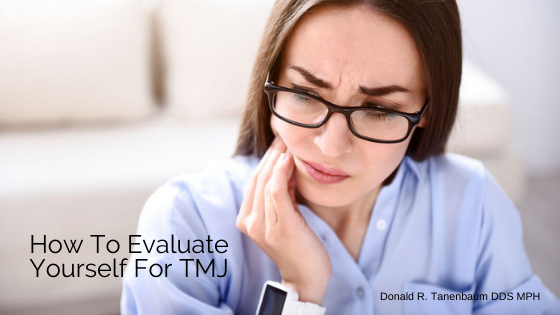
How To Evaluate Yourself For TMJ

Note: This article explains how to evaluate yourself for TMJ, what you can do about it, and how to determine when you need to get some professional help.

This past year’s pandemic challenges have led more people to seek care for TMJ problems than ever before. In fact, you may be reading this article because you’ve had your first experience of TMJ during the past year.

If you suffer from these kinds of problems, there are some steps you can take to relieve your symptoms. But before you try to evaluate yourself for TMJ, you must first understand the risk factors that led to your jaw being in trouble in the first place.

As an orofacial pain specialist for the past 35 years, I have treated thousands of patients who came to me suffering from jaw problems. They usually arrive at my office with complaints of jaw pain or stiffness, headaches in their temples, or facial pain that, in some cases, is taking over their lives. Many have limited jaw opening, joint popping and/or cracking. Some even experience locked jaws upon waking up in the morning.

While a traumatic event such as a car accident or an underlying medical disorder or treatment can be the culprit, for most people a wide variety of risk factors can cause TMJ pain problems. It is my job to properly diagnose, identify the causes, help my patients cope with TMJ – and eventually, get better.

Before You Evaluate Yourself For TMJ, You Must Understand What TMJ Is

The most important thing to understand about TMJ problems is that they are orthopedic in nature. Just like any other muscle and joint structure in your body – knees and shoulders, for example – if they become overworked, sprained, fatigued or injured, pain and instability will arise. Your jaw muscles and jaw joints (TMJs) are no different. An orthopedic problem can’t be treated until what is causing the pain is identified. It’s the same for TMJ problems.

How To Evaluate Yourself For TMJ – Identify The Cause & Make Changes

TMJ problems can involve your muscles, joints or both. To evaluate yourself for TMJ joint problems, pay attention to whether the pain is in front of your ear when you move your jaw or touch the area and if your jaw joints click, pop and/or lock. If you can answer yes to both questions, you should not try to cure yourself. See a dentist with experience in TMJ care or a TMJ specialist in your area right away. (There’s a link at the bottom of this page to the American Academy of Orofacial Pain, where you can find a specialist in your area.)

To evaluate yourself for TMJ muscle problems, you would probably describe your symptoms as soreness, stiffness, spasms or achiness. If you push your fingers firmly along your jawline or into your temples, you will experience more pain than you expected. Your jaw motion may be limited but it’s not accompanied by joint clicking or popping sounds.

If you’ve determined your TMJ problem is of the muscle variety, your next step is to figure out why and how your muscles became so irritable in the first place. To do so, you’ll need to do a little investigating to find out what is happening in your life during the day and at night.

6 Daytime Behaviors & Postures That Could Be Causing Your TMJ Problems

Starting today, pay careful attention to your daytime behaviors and postures, particularly while you’re working. Working behaviors and postures are some of the leading causes of TMJ problems. And, working at home is a big reason for the considerable increase of people seeking care during the past year.

When you evaluate yourself for TMJ of the muscle variety, look for these six common daytime behaviors that could be causing your jaw or neck muscles to fatigued:

  • Your head leans forward while you work at your computer.
  • You consistently look down at your phone.
  • You hold your breath or take shallow quick breaths with your mouth open.
  •  You brace your jaw muscles (but your teeth are not clenched).
  • You often keep your teeth clenched.
  •  You bite your nails and/or cuticles, cheeks, lips or tongue.

Did you identify any of the six behaviors or postures above during your workday? If you said yes, believe it or not, that is good news! Because if you can start eliminating them right away. And there’s a pretty good chance you can start feeling better right away, too.

Start by paying attention to your breathing patterns. If you discover that you hold your breath or breathe shallowly, go online and search for “restful breathing techniques.” You’ll see a lot of results and almost any you choose will help. Also, take more breaks. And make some adjustments to your workstation to improve your head posture. (Here’s a helpful guide). Also, download a reminder app such as Time Out for Mac that will help you remember to take breaks.

5 Nighttime Factors That Could Be Causing Your TMJ Problems

An essential step in evaluating yourself for TMJ is identifying what is happening to your jaw muscles, jaw joints or neck muscles while you’re asleep. This, understandably, is not easy – but it’s definitely doable. If you consistently wake up with jaw or neck pain, tightness in your jaw, or headaches – you can assume one or more of the following four factors are present:

  • Insomnia – You have trouble falling asleep or staying asleep.
  • Fragmented Sleep – Your sleep is full of lots of small arousals. Your brain wakes you up numerous times during the night.
  • Inadequate Sleep – You routinely get less than the recommended hours of sleep. (See the link at the bottom of this page to determine what is recommended for your age group).
  • Bruxism – You clench and/or grind your teeth while you sleep.
  • Breathing Problems – You struggle with breathing due to nasal or other airway restrictions while you sleep.

If you suspect factors 1, 2 or 3, try one or more of the following:

  • Take melatonin at bedtime.
  • Don’t drink coffee after noon.
  • Don’t use your electronic devices late into the evening.
  • Stop all work-related activities one hour before going to bed.
  • Read a good book.
  • Exercise in the morning instead of after work.
  • Eat dinner earlier.
  • Practice some breathing exercises before you get into bed.
  • Try some gentle stretching or yoga before bed.

If you suspect factor 3 – Bruxism – this is for you:

If you wake up occasionally with sore teeth but nothing more severe than that, consider purchasing an over-the-counter oral appliance at your local pharmacy. (Note: there are many terms for oral appliances such as mouthguards, bite plates, and teeth protectors – they all mean pretty much the same thing.)

If your symptoms get better after wearing your over-the-counter oral appliance at night for several weeks, your next step is to visit your dentist to be fitted for a custom oral appliance. This is very important because wearing an oral appliance over a long period of time that is not custom-fitted can lead to complications such as shifting teeth, bite changes and even airway obstruction.

If your symptoms do not get better after wearing your over-the-counter oral appliance it’s time for you to get some professional help. Make an appointment with your dentist or an orofacial pain specialist. (See the link at the bottom of this page to the American Academy of Orofacial Pain to find an orofacial pain specialist).

If you suspect Factor 4 – Breathing Problems – here’s what to do:

If your self-evaluation for TMJ leads you to suspect you have a nighttime breathing problem – it may be sleep apnea and you must see a sleep professional right away. Your struggle to breathe at night is likely reducing airflow and causing your blood oxygen to lower. That places excess stress on your body.

You should opt for an overnight sleep evaluation monitored by a professional. (Link here to find a sleep center near you.) If the sleep evaluation indicates you do have a sleep breathing disorder such as apnea, there are many options for you after the sleep study. You may be told to sleep on your side, wear nasal strips, use a custom-made oral appliance, or lose weight. Many people find that a continuous positive airway pressure (CPAP) machine is a lifesaver. (Read: What Is CPAP?) In severe cases, nasal surgery, orthodontics, jaw advancement or another correction surgery may be the solution.

How To Evaluate Yourself For TMJ – In Conclusion

Let’s say you have been able to get your TMJ problems under control by changing one or more of the six daytime behaviors above. That is great. And even if your nighttime behaviors are of the Factors 1, 2, or 3 variety and you tried some of the simple solutions I recommend, there’s a chance you’re already feeling better.

TMJ problems, however, are often caused by several risk factors. For you, relief may only be achieved with a professional approach. Take a little bit of time to find a trained orofacial pain practitioner in your area and you should be able to get on the road to feeling better very soon.

Helpful Links:

American Academy Of Orofacial Pain (Look for a provider with Diplomate status)

How Many Hours Of Sleep Are Enough For Good Health?

Categories
TMJ

FDA Looking At Conditions That Impact Quality Of Life


There are hopes that TMD will be included.

I’m happy to announce some great news. The FDA (The Food & Drug Administration) is taking a closer look at medical conditions that can have a significant impact on your quality of life. Starting in 2016 the FDA will hold public meetings with the goal of determining the impact on daily life of 20 chosen diseases, and to look at the scope of services that are available to treat these conditions.

The TMJ Association is making huge efforts to have TMD (Temporomandibular Disorder) chosen as one of the diseases that will be focused on. That TMJ problems affect your quality of life is not news if you are one of estimated 35 million Americans who suffer from it every day.

Chronic pain problems, like TMD, rarely occur alone. It is estimated that 85% of TMD patients have other chronic pain conditions such as headaches, endometriosis, fibromyalgia, interstitial cystitis, irritable bowel syndrome, chronic fatigue syndrome, sleep disorders, or vulvodynia. In many cases these conditions are so complicated that patients don’t know where to turn to for care. As a matter of fact, I see many patients every week who have been told that they will never get better and that their problem is in “the head.”

If chosen as one of the conditions to be studied by the FDA, more information will be made readily available to you, the public, as to the nature of TMD and the treatments that are available.

Here are some facts about TMD that more people need to know:

  • TMD problems are orthopedic in nature.
  • TMD problems may be the result of (or aggravated by) rheumatologic, autoimmune or neurologic conditions.
  • Women are the largest group with TMJ symptoms as a result of specific biologic predispositions, some of which are hormone-driven.
  • Common TMJ problems may be the result of an accident, overusing the jaws, bad posture, teeth grinding (bruxism), or muscle tension caused by by emotions and life’s challenges.
  • Treatment for TMJ disorders should not focus merely on the teeth; the ultimate goal should be tissue healing and change of habits.
  • Getting better typically will lead to less pain, less medication, better function and increased optimism in people who before had anticipated a lifetime of suffering.

The same as with other orthopedic problems, after treatment patients may still have some pain, but it is likely that it will be at a much more tolerable level.

For all of you TMD/TMJ sufferers out there, the fact that the FDA has recognized that it’s time for this type of condition to be validated is welcome news. The result will be more access to information and thus, more access to treatment.


Dr. Donald Tanenbaum is a specialist with offices in New York City and Long Island, NY. He is uniquely qualified to diagnose and treat problems associated with facial painTMJ, and headaches.

Categories
Headaches TMJ

Transcendental Meditation Can Ease TMJ Symptoms and Headaches

In my practice I work with patients who suffer from facial pain, tight jaws, headaches (of a muscle or migraine variety), neck pain, or a combination of two or three symptoms. Some of my patients are poor sleepers and many of them grind and clench their teeth at night, resulting in problems with the TMJ (temporomandibular joint). But what most of these patients have in common is an extraordinarily high level of stress due to tension at work, overwhelming financial burdens, caring for aging parents, and more.

Sound familiar to you? Read on:

The logical way to reduce stress would be to make some big changes in your life, right? But that’s no simple task, if it’s possible at all. Unfortunately, when you live with stress over a long period of time your brain can become either fatigued, upset, or both. In this state you are more likely to develop physical ailments associated with the muscles of the head, neck and jaw. This perpetual state of mind-body imbalance can result in unhappy muscles resulting in facial pain, stiffness, spasms, limited head or jaw motion, and/or frequent muscle or migraine headaches.

The question then becomes “Are there treatment strategies that deal with the source of unhappy muscles instead of merely dealing with the end result?” This is where Transcendental Meditation (TM) comes in. Though it is far from being the only technique that addresses brain fatigue and upset, there is increasing scientific evidence that suggests that TM can help achieve mind-body balance.

How does TM work to ease TMJ symptoms and headaches?

The practice of TM promotes restful alertness of the mind. When you are in a restful alertness state there is improvement in the coordinated functioning of all parts of your brain (called EEG Coherence). EEG Coherence means that brain is operating in its most efficient way. In this state there is synchronization of the many types of brain waves communicating with your organ systems, and your organs are communicating in synchronization with your brain. When these communication pathways work well, muscles and joints are under a lower level of strain, they fatigue less, and they function more smoothly and easily.

Over time, people who practice TM report less pain, decreased strain, and more comfort in their face, jaw, neck and head.

As a doctor whose specialty is treating pain I will always have patients who need prescriptions, muscle or joint injections, oral appliances, exercises, rehabilitation and other relaxation strategies. But I now strongly advise all my patients to consider making Transcendental Meditation a part of their daily routine. So far, the feedback from my patients who practice TM is very encouraging.

After a consultation in my office I can refer you to one of the TM centers that I work with; sometimes even enabling you to receive a lowered fee to be trained.

Do you practice TM? Please feel free to share your experience here:

Dr. Donald Tanenbaum is a specialist with offices in New York City and Long Island, NY. He is uniquely qualified to diagnose and treat problems associated with facial pain, TMJ, and headaches.

Categories
Case Studies Facial Pain Headaches Women & Pain

Headaches & Facial Pain Caused by Emotional Distress

Caring for the Caregiver

Case Study: Joan

Joan was referred to my office due to her daily headaches and facial pain that had continued to get worse despite taking over-the-counter medication on a daily basis and treating herself to a few massage sessions. She had seen her family doctor who had assured her that there was nothing terribly wrong, that the headaches and facial pain were a result of stress, and that she should start exercising more frequently and try to get more sleep.

Joan came to me when she could no longer tolerate the pain. After careful listening and a full examination, it was clear to me that her pain likely had a muscle origin. For Joan, along with countless other people in America and across the globe, her aching facial, jaw, and neck muscles were undoubtedly the result of an ongoing burden that had begun to dominate her life. Joan’s particular burden was that six months prior, her husband had suffered a debilitating stroke and she had become his sole caregiver.

Joan’s world had changed overnight. She was now a full time, worrier, cook, chauffeur, appointment maker, and sole provider of her husband’s physical and emotional needs. Although she took on these responsibilities with love and commitment, it was clear that she had been unprepared for the enormous challenges she faced. As the weeks and months passed, friends and family retreated to their own worlds, and she was left to fill the voids in her husband’s life, knowing that this job came with an unknown future.

As a result of her daily caregiver obligations, Joan’s sleep suffered, her independence all but disappeared and her ability to exercise and stay healthy dwindled to almost nothing. Suddenly her neck ached, headaches emerged, and she found herself gritting her teeth during the day as she tried to maintain patience and deal with the physical effort it required to get her husband showered, dressed, and fed.

Joan’s headaches and facial pain were clearly the result of  muscles that were in crisis as a result of a ‘brain under siege’ and muscle fatiguing behaviors (clenching/raised shoulders…) that were prompted by the realization that she was alone and unprepared for an unknown future. The more Joan and I talked, the more I realized that not only was she suffering with pain, but she was lonely and depressed as well.

To help address Joan’s sore and painful jaw, face and neck muscles, I set her up with number of common therapies. These included “physical self regulation techniques” which help patients identify and change the behaviors that they have developed as a result of ongoing life challenges and stressors.

Just becoming aware of when the brows are furrowed, the lips are tense, the shoulders are raised, the jaw muscles are braced, or the teeth are clenched is the first step. I then taught her a number of exercises and breathing techniques that reduce muscle tension and can lead to significant pain relief over time. To complement these self-care efforts, we added medications, muscle injections, oral appliances, and physical therapy.

Though as a result of these efforts Joan felt somewhat better (in spite of the fact that nothing had actually changed in her life), there clearly was more that had to be done to help Joan not fall back into her acute pain state once formal treatment in my office stopped. That is when I introduced her to the Caregivers Survival Network, founded by Adrienne Gruberg.

By joining The Caregiver Survival Network (CSN), she became part of a community of other caregivers eager to interact, share stories and be a source of support. She found a lot of free services geared exclusively to a caregiver’s needs and links to other organizations and websites for caregivers, as well. As a result of taking advantages of the ideas and services shared on the CSN, her feelings of being alone started to dissipate and I feel that Joan is on the mend both physically and emotionally.

If you are in a similar situation, or know someone who is, please direct him or her to http://www.caregiversurvivalnetwork.com/