
Clinical Takeaway
When non-surgical care is exhausted and jaw pain, locking, restricted motion, or bite change persist, temporomandibular joint surgery becomes a realistic option. The decision rests on whether symptoms, examination findings, and imaging confirm structural joint compromise. Only a small number of TMD patients ultimately require surgery. This framework is not a case for or against it. It reviews the criteria and supports collaborating with a specialist on which option fits the situation.
Amidst the thousands of patients my colleagues and I have seen with temporomandibular disorders, there have been times when non-surgical care has fallen short. The reasons vary, and often the eventual need for surgery was not anticipated at the outset. Surprisingly, a specific traumatic event is rarely the determining factor. More often, slowly developing joint compromise is part of the story, with low-grade pain or benign, non-painful clicking escalating over time.
The common factors that undermine joint integrity include:
Trauma: A single traumatic event can initiate serious joint damage that ultimately requires surgery; however, this scenario is not the most common pathway. Sports injuries, motor vehicle accidents, and medical and dental traumas can all lead to unstable and symptomatic TMJs that don’t respond to non-surgical care. If, over time, the resultant traumatically initiated tissue injury in the joint progresses, surgery may become a reality.
Persistent overload: It is important to remember that jaw problems are essentially orthopedic problems. As a result, persistent overload to the TMJs, including sleep-related tooth clenching or grinding, and/or jaw overuse behaviors during the day can potentially put enormous strain on the joint tissues leading to irreversible tissue damage and inflammation that drive pain and mechanical limitations. Mind-body influences and fragmented sleep can be influential in these pathways.
Medical conditions: Conditions such as rheumatoid arthritis, psoriatic arthritis, lupus, osteoarthritis, Ehlers-Danlos syndrome, and Lyme disease, amongst many others, can make the TM joint more structurally vulnerable and subject to inflammatory-driven pain. Though the symptoms may appear similar to those driven by other pathways, the outcome of treatments may be less predictable and influenced by the medical disease process.
Structural and bite-related considerations: Though it is the opinion of this practitioner that structural and bite-related considerations are much less likely when compared to the other pathways to structurally compromise the TMJs to an extent leading to surgery, mention is due. Structural and bite imbalances, then, can be considered risk factors over time, particularly when coupled with persistent overload, traumatic impacts and medical conditions.
Ultimately, with the emergence of pain or locking events, patients seek care in our offices when a cautious diet and anti-inflammatory medications do not produce satisfactory results. In these scenarios, symptoms and examination findings are commonly related to disc interference disorders with associated inflammation, loss of condyle structural integrity, various arthritic conditions, and muscle guarding. MRIs often confirm the suspected joint compromises.
Knowing which of the above stated risk factors were likely responsible for the joint compromises will be a key ingredient in determining the outcome of the surgery if in fact pursued.
Why surgery remains a reserved option
Remarkably, despite these symptoms of clicking, locking, and pain, and an MRI that reveals disc displacement, effusions, and related pathology, only a small number of patients ultimately require surgical intervention. That is a testament to the ability of compromised joint structures to respond to care, and it therefore frames temporomandibular joint surgery as a reserved option for patients who have exhausted comprehensive non-surgical care without adequate relief.
The framework that follows is adapted from the chapter on surgical management in my new book, Lockjaw: A Human Problem, where it comes only after the non-surgical approaches that resolve most cases.
What actually drives the decision to operate
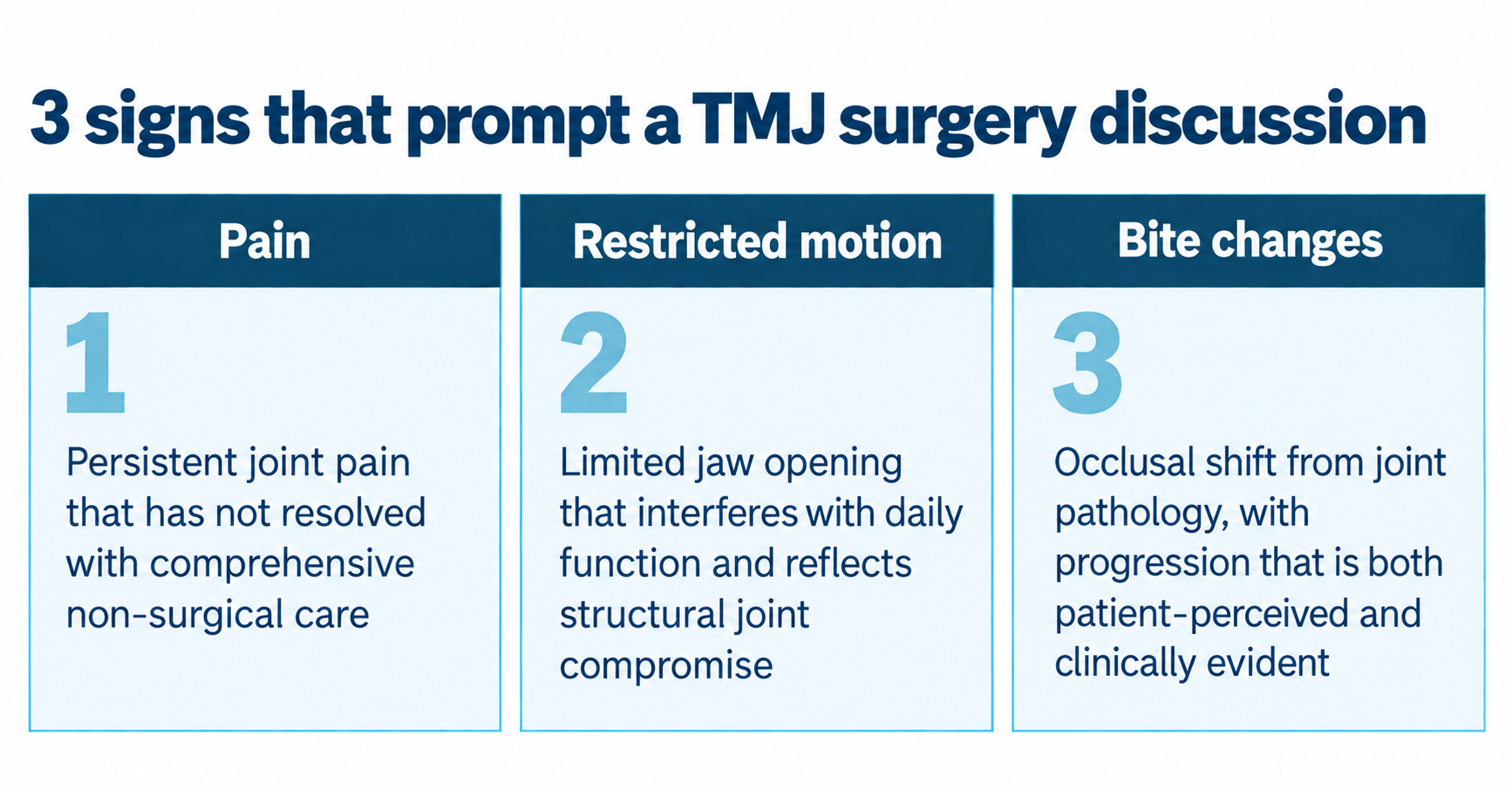
Pain
Most commonly, pain is the factor that leads to a surgical treatment plan. There are countless scenarios in which disc displacement and joint arthritis of many types are not associated with pain, or where pain that was present resolves with a combination of care and time.
Restricted motion
Restricted jaw motion that has not improved despite non-surgical therapy, and that interferes with daily jaw function, is the next likely reason a surgical treatment plan is chosen, as long as structural compromise in the joint is the reason motion is limited. Most often, restricted motion is accompanied by pain, which makes the decision easier, but not always.
Bite changes
Along with pain and motion restrictions, changes in the patient’s occlusion as a result of joint pathology may ultimately be the factor that prompts surgical treatment discussions. When there is significant arthritic disease or loss of condylar shape and volume due to persistent inflammation, it is common for a patient’s occlusion to be dominant on one side. When coupled with pain and a sense of progression, both patient-perceived and clinically evident, a surgical option is often justified.
The surgical spectrum: matching decisions to pathology
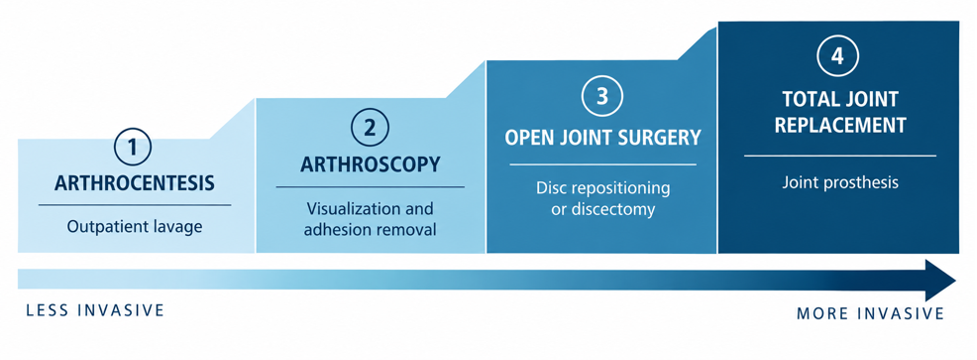
Arthrocentesis
Commonly performed in an outpatient setting under sedation, arthrocentesis washes out the joint to reduce inflammation and release adhesions, with the goal of reduced pain and improved jaw motion. Condyle and disc pathology is not reversed, but the biochemical environment is improved, providing opportunities for adaptation and healing. Hyaluronic acid (a lubricant), corticosteroid, or PRP/PRF are commonly injected into the symptomatic joint once lavage is complete. This option suits:
- Painful acute or persistent closed lock
- Painful clicking without significant mechanical obstruction
- Inflammatory joint conditions, including arthritic conditions
It is important to remember that arthrocentesis does not restore normal disc position, but it can help push a displaced disc into a better position, facilitating improved condylar movement and healing. The procedure can often be repeated a few months later to build on the pain relief and motion improvement achieved the first time.
Arthroscopy
Commonly performed under general anesthesia, arthroscopy adds direct visualization of the joint, allowing more extensive adhesion removal, biopsy, and disc mobilization. It is best suited for persistent, painful limited opening that has not responded to non-surgical therapy or to arthrocentesis.
It is not commonplace for this procedure to secure a displaced disc into a normal position, though some surgeons report success doing so. As with arthrocentesis, hyaluronic acid, steroid, PRP/PRF, or stem cells may be injected during the procedure. The goal is to give the joint a chance to mount an adaptive response despite the pathology identified clinically and on MRI/CT imaging.
Open joint surgery
This option becomes relevant when less invasive approaches have failed. Once the joint pathology is fully visualized, several options are available:
- Disc repositioning preserves an intact but displaced disc when caught early
- Discectomy removes a disc that is torn, perforated, or too damaged to preserve, often followed by a temporalis muscle flap or fat graft to cushion the joint space and reduce the risk of bone-on-bone deterioration, particularly in younger patients
- Removal of inflammatory tissue, smoothing of irregular condyle surfaces, and reduction of eminence steepness are additional considerations often addressed during these procedures
Total joint replacement
Total joint replacement remains the last resort, reserved for end-stage joint disease, ankylosis, congenital malformation, or failed prior surgery. Outcomes for pain and function are generally favorable, though long-term stability beyond 10 to 15 years remains an area of ongoing study. With advances in imaging and AI-assisted planning, the surgical time required to install these joint replacements has been significantly reduced, with a corresponding improvement in postoperative recovery.
Surgery doesn’t stand alone
No TMJ surgery exists in isolation. The most successful outcomes occur within a coordinated team approach that includes:
- Preoperative physical therapy to optimize motion and address myofascial contributors
- Careful psychological assessment to confirm realistic expectations
- Structured postoperative medication, dietary caution, and rehabilitation to prevent relapse
- Ongoing management of the daytime and nocturnal parafunctional habits that may have contributed to the original problem
In cases where a medical disease affecting bone and connective tissue has been identified, involvement of a rheumatologist may be essential.
Referral considerations
Surgery is not a first choice. If a patient reports being offered surgery before non-surgical options have been genuinely exhausted, a second opinion is worth encouraging.
When surgery does become necessary, today’s options are matched deliberately to the specific pathology in front of us, starting with the least invasive approach that can reasonably address the problem.
To Our Colleagues In The New York City Metropolitan Area
If your practice is located in the New York City metropolitan area, New York TMJ & Orofacial Pain has four locations staffed by board-certified orofacial pain specialists ready to help your patients. We provide evidence-based, multidisciplinary care and collaborate closely with referring providers to assist in the diagnosis and management of patients with complex TMD and orofacial pain conditions.
Contact one of our offices →
About the author
Dr. Donald R. Tanenbaum is a co-founder of New York TMJ & Orofacial Pain. He provides care at our Manhattan and Hauppauge locations. He is the author of Lockjaw: A Human Problem and co-author of Doctor, Why Does My Face Still Ache?.
Further resources
- Systemic Causes of TMD: Autoimmune, Endocrine, Infectious, and Inflammatory Disorders
- Meet Our Team
- Treatments We Provide
Frequently asked questions about temporomandibular joint surgery
When should a TMD patient be referred for a surgical evaluation?
A surgical referral is appropriate once non-surgical care has been genuinely exhausted, and the patient still has pain, locking, or restricted motion that limits jaw function, and imaging supports loss of joint structural integrity.
How common is surgery among patients treated for TMD?
Uncommon. Only a small number of patients treated for TMD ultimately require surgical intervention, even when imaging shows disc displacement or joint pathology. Surgery is reserved for patients who have not achieved adequate relief through comprehensive non-surgical care.
What surgical options exist for TMJ disorders, and how are they chosen?
Options run from least to most invasive: arthrocentesis, arthroscopy, open joint surgery, and total joint replacement. The choice is matched to the specific pathology identified, starting with the least invasive approach that can reasonably address the problem, with total joint replacement reserved for end-stage disease, ankylosis, congenital malformation, or failed prior surgery.
Selected references
- A guide for temporomandibular joint surgery using a simple surgical classification: a narrative-style review. Dimitroulis G. Journal of Cranio-Maxillofacial Surgery. 2024;52(10):1116-1121.
- Recent advances in temporomandibular joint surgery. Wroclawski C, Mediratta JK, Fillmore WJ. Medicina. 2023;59(8):1409.
