
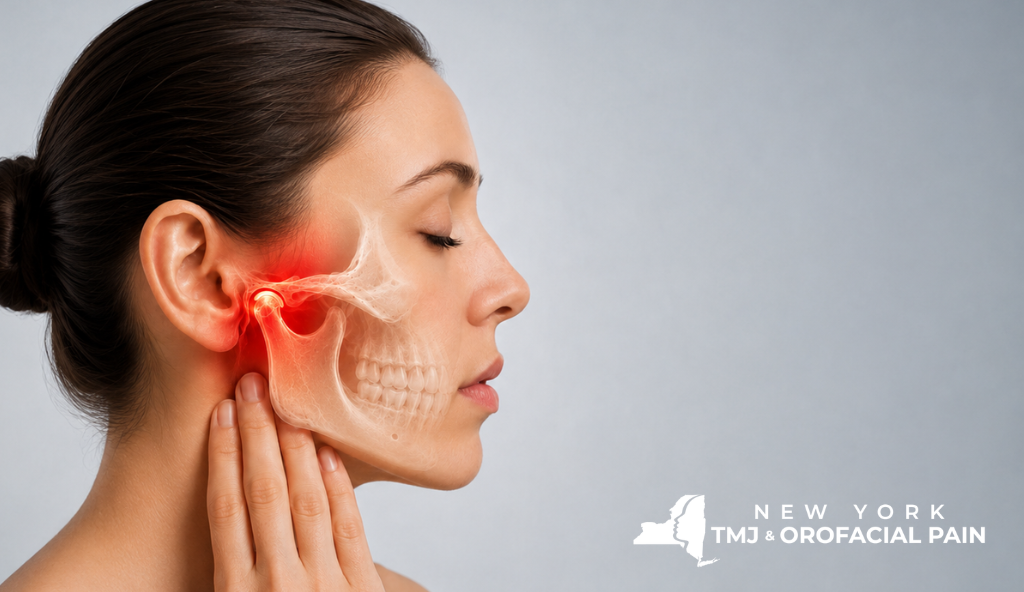
How autoimmune, endocrine, infectious, and inflammatory disorders contribute to jaw muscle and joint pain.
Clinical Takeaway
Persistent jaw pain, facial pain, and limited opening do not always originate within the masticatory system. Autoimmune disease, endocrine dysfunction, anemia, infectious disease, and chronic inflammation may contribute to TMD symptoms and should be considered when conventional treatment approaches fail to produce expected results.
Temporomandibular disorders are commonly framed as problems of the jaw, inclusive of the muscles, the disc, and the joint. In many patients that framing is accurate enough. A direct trauma, a prolonged dental procedure, the accumulated mechanical burden of daytime clenching and nocturnal bruxism. These are the familiar stories, and they lead to familiar treatments.
But in a meaningful proportion of patients…
The jaw is not the origin of the problem. It is the destination.
The muscles ache and the joints inflame not because something happened to the jaw specifically, but because the systemic environment in which the jaw operates has been compromised. This may be the end result of autoimmune disease, metabolic dysfunction, chronic inflammation, medications, or by the quiet but consequential presence of conditions that no one has connected to the presenting complaint.
For clinicians in dental and medical practice who encounter patients with jaw pain, facial pain, and limited opening that does not have a history that makes total sense and/or does not respond predictably to conventional TMD management, this newsletter is intended as a clinical prompter. Salient medical disorders commonly seen in our offices will be briefly reviewed, highlighting the need for ongoing collaboration with physicians and other healthcare providers.
The muscle pain problem: ischemia, oxygen, and the autonomic nervous system
Before addressing specific medical conditions, it is worth establishing a foundational principle.
Myalgia, or muscle pain, is in many cases a problem of oxygen delivery.
Muscles that are inadequately perfused, or perfused with blood that carries insufficient oxygen, lead to the accumulation of lactic acid and inflammatory byproducts. This accumulation leads to the activation of pain receptors and the progressive nerve sensitization that results.
Two systemic mechanisms drive this in ways directly relevant to jaw muscle pain.
Autonomic dysregulation
The first is autonomic dysregulation.
Chronic activation of the sympathetic nervous system, whether driven by anxiety, unresolved psychological stress, sleep-disordered breathing, or systemic inflammatory disease, maintains a state of peripheral vasoconstriction that reduces capillary perfusion in skeletal muscle. The masticatory muscles are not exempt.
A patient whose autonomic nervous system is chronically in a threat state arrives at every chewing cycle and every night of sleep with muscles already working at a perfusion deficit.
Anemia
The second is anemia.
This is among the most commonly overlooked contributors to diffuse musculoskeletal pain in clinical practice, including jaw muscle pain.
When hemoglobin is reduced, regardless of cause, the oxygen-carrying capacity of the blood is diminished, and muscles throughout the body, including the masticatory group, become more vulnerable to fatigue, cramping, and aching with normal use.
Iron deficiency anemia, disproportionately common in premenopausal women, presents in this way. Anemia of chronic disease, arising in the context of autoimmune conditions or chronic inflammation, produces the same muscular consequence. B12 and folate deficiency anemias contribute through both reduced oxygen delivery and direct neuromuscular effects.
Clinical consideration
A basic blood panel inclusive of:
- Complete blood count (CBC)
- Iron studies
- Ferritin
- Vitamin B12
- Folate
is an inexpensive and accessible starting point when diffuse jaw muscle pain does not fit the reported history or examination findings.
Autoimmune and inflammatory conditions
Rheumatoid arthritis
Rheumatoid arthritis involves the TMJ in a small but relevant proportion of patients.
The same synovial inflammation that drives cartilage and bone erosion in the hands and wrists operates identically in the temporomandibular joint.
Clinical clues may include:
- Bilateral preauricular pain
- Morning jaw stiffness
- Restricted jaw opening
- Joint pain involving the hands and wrists
- Progressive condylar erosion on imaging
- A developing anterior open bite
A patient presenting with bilateral TMJ inflammatory pain alongside joint pain in the hands and wrists who has not been evaluated rheumatologically deserves referral and serological testing.
The anti-CCP antibody, rheumatoid factor, ESR, and CRP will provide the essential serological picture.
Reactive arthritis and COVID-19
Reactive arthritis, which is defined as joint inflammation triggered by a previous infectious event, has been increasingly reported following COVID-19 and has unquestionably been seen in practice.
Post-COVID reactive arthritis can involve multiple joints asymmetrically, and TMJ involvement has been seen in practice.
It is thought that an immune system that has been under siege may remain poorly regulated after the initial infectious event, producing synovitis that may persist long after the original illness has resolved.
In a patient whose jaw joint pain began in the weeks to months following COVID without prior TMD history, this association is worth considering.
Systemic lupus erythematosus
Lupus can impact the jaw and masticatory system through its association with a high inflammatory burden throughout the body which sensitizes both peripheral and central pain systems.
In addition, the profound fatigue and sleep disruption associated with lupus can compromise tissue healing.
Since lupus commonly presents without the classic butterfly rash, diagnosis is often delayed.
A potentially recognizable pattern in a young woman would include:
- Bilateral joint pain
- Fatigue
- Oral ulcers
- Photosensitivity
- Raynaud’s phenomenon
In the absence of a history that could explain the onset of a common TMD problem, ANA screening and a rheumatologic referral are suggested regardless of whether any rash is present.
Psoriatic arthritis
Psoriatic arthritis produces both synovial joint inflammation and inflammation at tendon and ligament insertion sites relevant to the temporomandibular complex.
TMJ involvement is well documented and may precede or follow the skin manifestations.
Because psoriatic arthritis is classified as seronegative, it will not be identified through standard rheumatoid arthritis serological screening. The diagnosis rests on clinical pattern recognition and rheumatologic assessment.
Hashimoto’s thyroiditis
It would be difficult to overstate how frequently Hashimoto’s thyroiditis appears in the medical histories of women presenting to this practice.
The association is not incidental.
Hashimoto’s thyroiditis, the most common cause of hypothyroidism, produces diffuse myalgia, joint stiffness, fatigue, and slowed tissue repair that directly compromises the jaw and cervical musculature.
In addition, hypothyroidism contributes to the non-restorative sleep that sustains central sensitization.
TSH screening with free T4 and thyroid peroxidase antibodies when indicated is a routine and accessible investigation.
Inadequately treated hypothyroidism, including patients whose TSH is technically within range but sub-optimally managed, can be a significant contributor to persistent TMD symptoms.
Lyme disease
On Long Island, New York, where New York TMJ & Orofacial Pain maintains its Suffolk County office, Lyme disease represents a genuine and locally prevalent contributor to joint and muscle pain that can present at the jaw before a systemic diagnosis is established. As Long Island lies within one of the highest-incidence Lyme disease regions in the United States, this diagnosis must be considered in our patient population.
Lyme arthritis typically involves multiple joints, and the TMJ is a documented site.
A patient with jaw joint pain, fatigue, arthralgias in multiple sites, and a history of outdoor exposure in endemic areas deserves Lyme serological testing, even in the absence of a recalled tick bite or rash, both of which are frequently absent.
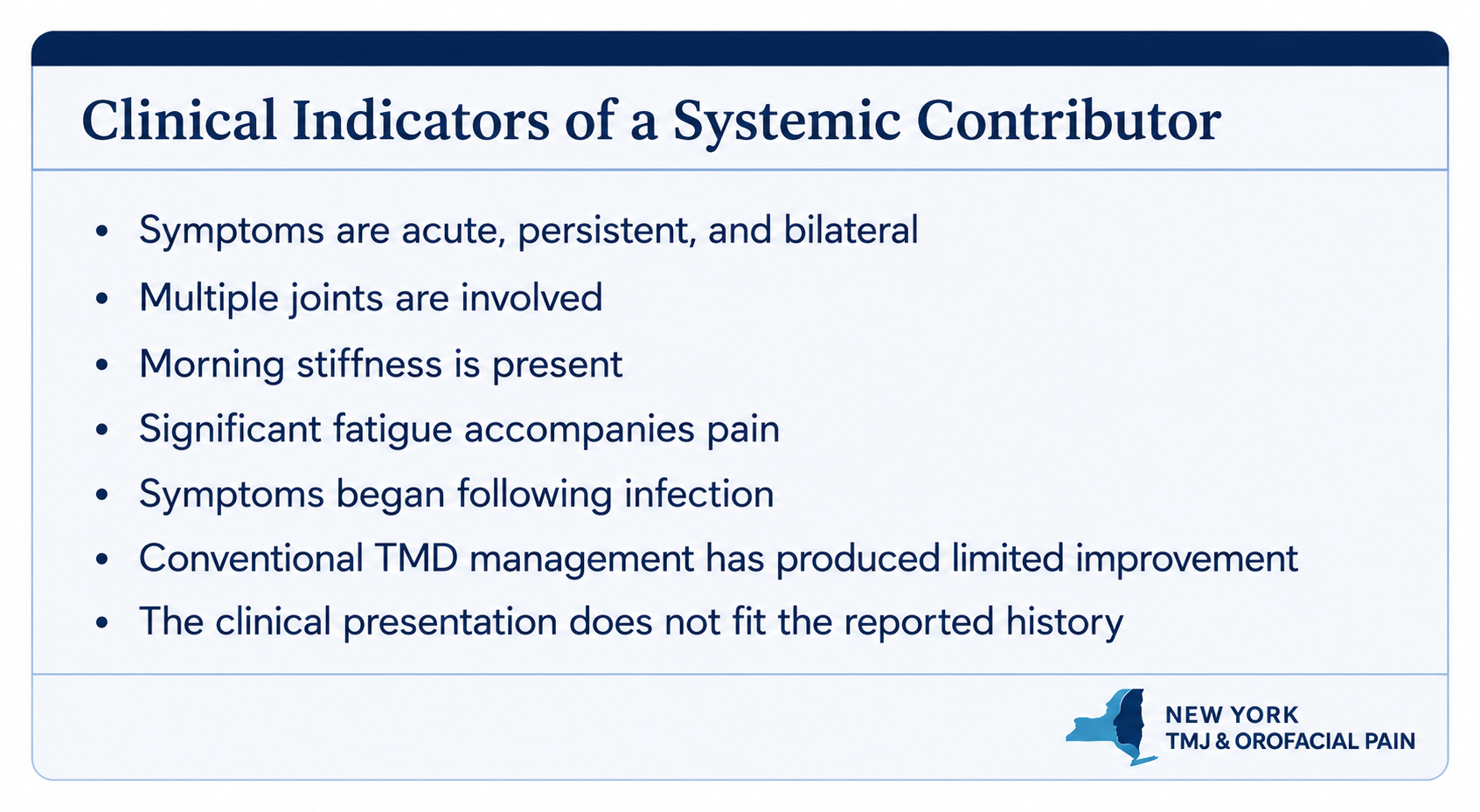
When should clinicians suspect a systemic contributor?
Based on 40 plus years of past experiences evaluating patients with TMD symptoms, a broader medical evaluation should be considered when:
- Symptoms are acute, persistent, and bilateral
- Multiple joints are involved
- Morning stiffness is present
- Significant fatigue accompanies pain
- Symptoms began following infection
- Conventional TMD management has produced limited improvement
- The clinical presentation does not fit the reported history
Summary
This list of medical disorders that drive jaw-related symptoms is a nod to the complexity of the problems we often see in our offices with increasing frequency.
As a result, medical collaboration has become that much more important.
Read the related clinical resource, Medications That May Contribute to TMD and Orofacial Pain, to learn how medication review can provide valuable clues when evaluating patients with persistent orofacial pain.
To our colleagues in the New York City metropolitan area
If your practice is located in the New York City metropolitan area, New York TMJ & Orofacial Pain has four locations staffed by board-certified orofacial pain specialists. We provide evidence-based, multidisciplinary care and collaborate closely with referring providers to assist in the diagnosis and management of patients with complex TMD and orofacial pain conditions.
Contact one of our offices →
About the author
Dr. Donald R. Tanenbaum is a co-founder of New York TMJ & Orofacial Pain. He provides care at our Manhattan and Hauppauge locations.
Relevant links
References
Frequently asked questions about systemic causes of TMD
Can autoimmune diseases contribute to TMD symptoms?
Yes. Autoimmune disorders such as rheumatoid arthritis, systemic lupus erythematosus, psoriatic arthritis, and Hashimoto’s thyroiditis may contribute to jaw pain, masticatory muscle pain, TMJ inflammation, and other TMD symptoms. In some patients, jaw symptoms may be among the earliest manifestations of systemic disease.
Can anemia contribute to jaw muscle pain?
Anemia reduces the oxygen-carrying capacity of the blood and may contribute to muscle fatigue, cramping, and aching. When diffuse jaw muscle pain does not fit an expected mechanical pattern, laboratory evaluation may be warranted.
Can Lyme disease affect the TMJ?
Yes. Lyme arthritis may involve the temporomandibular joint and should be considered in patients presenting with jaw pain, fatigue, and arthralgias, particularly in endemic regions such as Long Island and the northeastern United States.
What medical conditions should be considered when evaluating persistent TMD symptoms?
Medical conditions that may contribute to TMD symptoms include autoimmune disorders, thyroid disease, anemia, post-viral inflammatory conditions, Lyme disease, and other systemic illnesses that affect muscles, joints, and pain processing pathways.
When should clinicians suspect a systemic contributor to TMD symptoms?
A broader medical evaluation should be considered when symptoms are bilateral, involve multiple joints, are associated with fatigue or inflammatory findings, begin following infection, or fail to respond predictably to conventional TMD management.
When should referral for additional medical evaluation be considered?
Referral may be appropriate when the clinical presentation does not fit a typical mechanical TMD pattern, when symptoms are widespread or progressive, or when findings suggest an underlying autoimmune, endocrine, infectious, or inflammatory disorder.
Can thyroid disease contribute to TMD symptoms?
Yes. Hypothyroidism associated with Hashimoto’s thyroiditis may contribute to diffuse muscle pain, joint stiffness, fatigue, sleep disturbance, and delayed tissue recovery, all of which may influence TMD symptoms.
Can COVID-19 be associated with jaw joint pain?
Post-viral inflammatory conditions, including reactive arthritis following COVID-19 infection, have been associated with joint pain and inflammation. In some cases, TMJ symptoms may develop in the weeks or months following infection.
