
If you’ve been dealing with frustrating and sometimes debilitating ringing, buzzing, or humming in your ears and haven’t been able to find relief, it’s time to consider the possibility that your temporomandibular joints (TMJs) are playing a role. As Orofacial Pain specialists, we’re experts at dealing with jaw-related problems. We understand your challenges and how they could be negatively affecting your life, and we’d like to provide you with some clear and understandable information that can help you determine if TMJ is involved with your symptoms.
You’re Not Alone.
According to a 2022 systematic review published in the Journal of the American Medical Association (JAMA), more than 740 million people worldwide experience tinnitus. The National Institute on Deafness and Other Communication Disorders (NIDCD) estimates that over 25 million Americans (10% of the U.S. adult population) suffer from some form of the condition.
Here’s How Tinnitus and TMJ Can Be Linked
Tinnitus is defined as the perception of sound that doesn’t have an external source. It is most likely to affect people ages 45 years old and older. And, while tinnitus can have various causes – such as noise exposure, medication use, infections, and even head trauma – there’s a lesser-known possibility: a connection between tinnitus and TMJ.
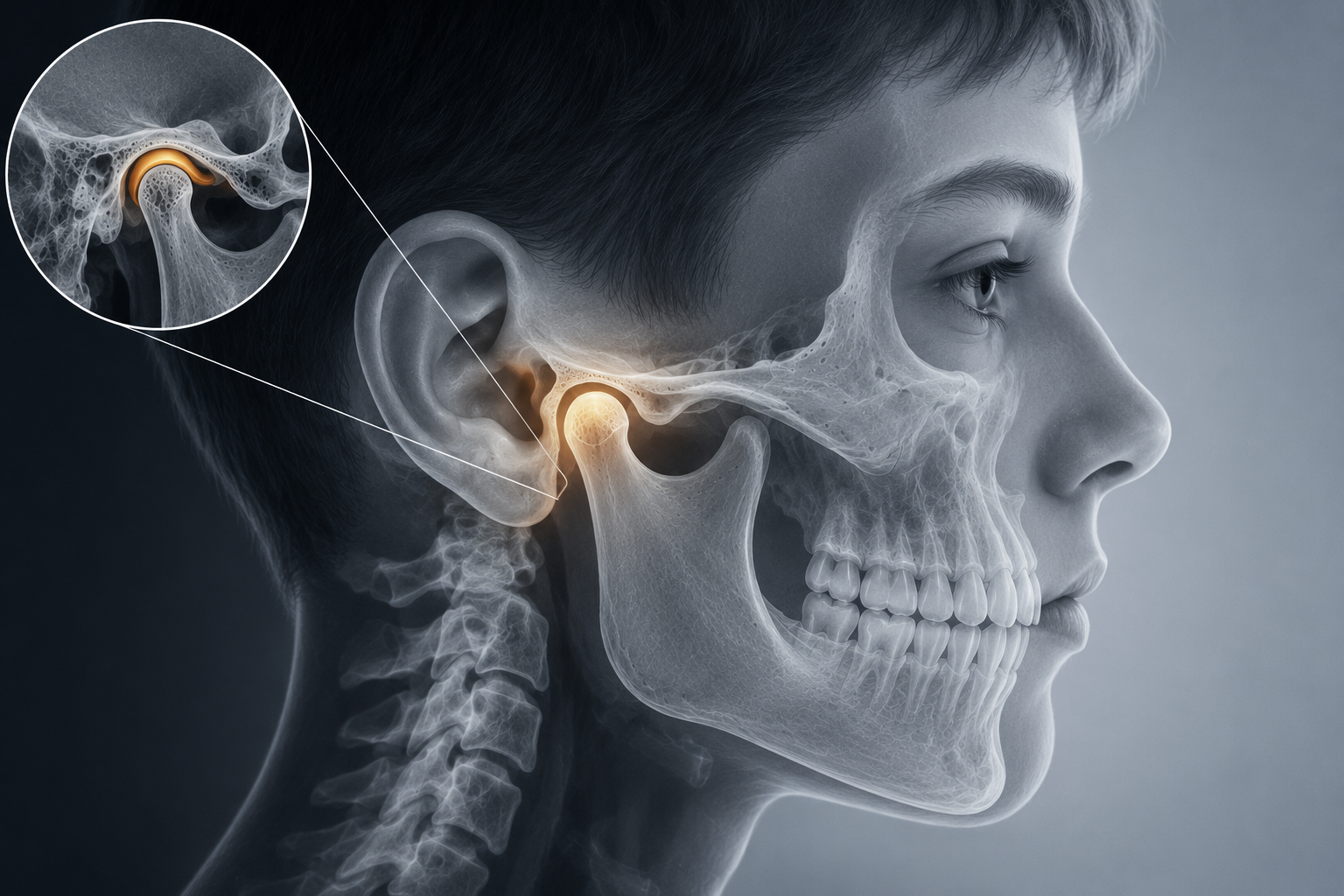
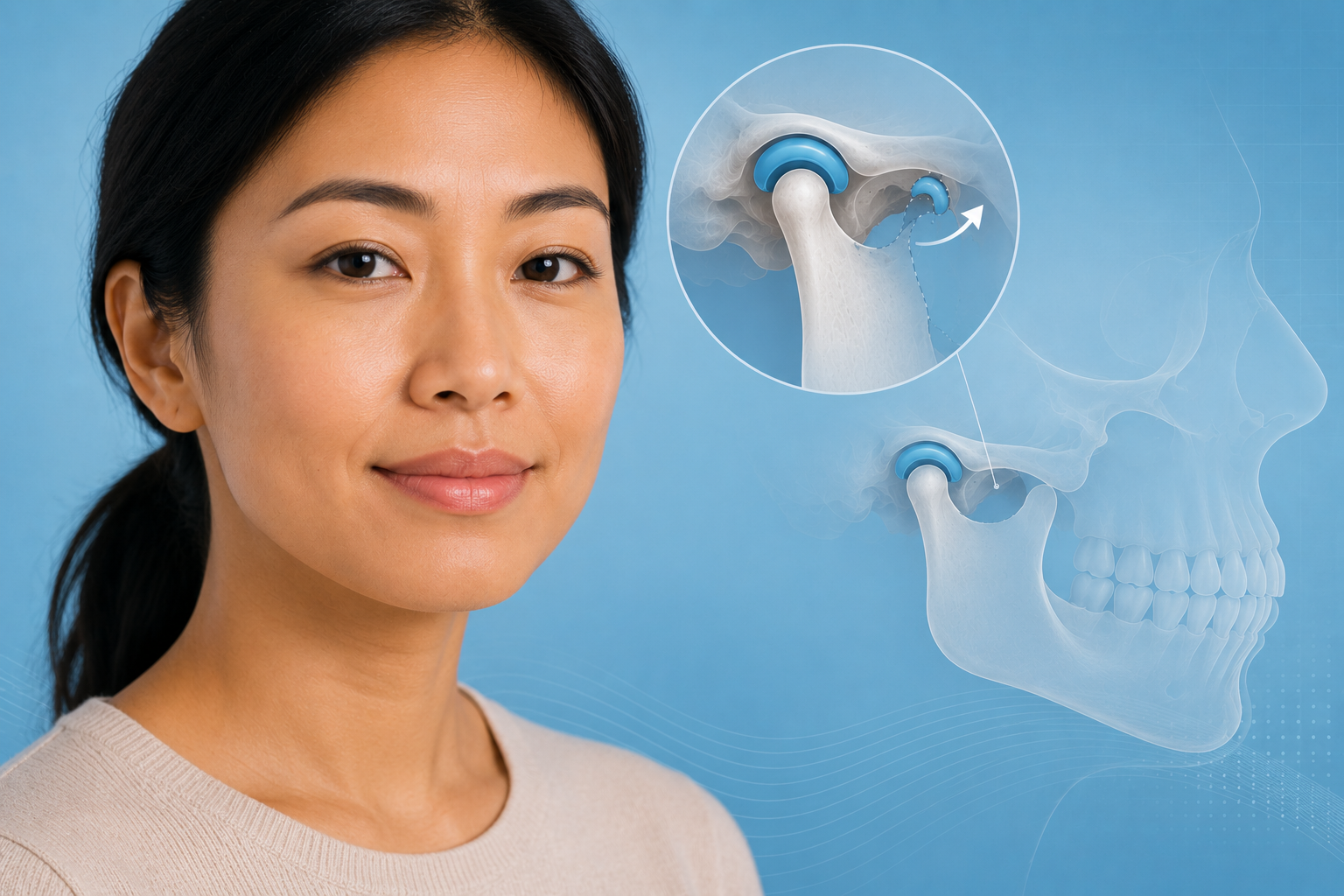
An intricate relationship between your ears and jaws sheds light on the possible connection between tinnitus and TMJ. Specific structures in our ears and jaws develop simultaneously from similar tissues, which has led researchers to believe that issues with temporomandibular joints and the muscles and ligaments that control them, may have an effect on the ears and contribute to tinnitus symptoms.
Is Your Tinnitus Linked To TMJ? – 5 Questions
To determine if your tinnitus symptom TMJ may linked to TMJ, answer these 5 questions:
- Does the intensity or character of your symptoms change from one day to the next?
- Do your symptoms change when you open or close your mouth or move your jaw forward or back?
- Does chewing food affect the intensity of your tinnitus?
- Do your tinnitus symptoms change when you clench your teeth?
- Do your symptoms worsen when you turn or tilt your head?
What To Do Next
If you answered yes to one or more of the above questions, we have some good news for you: There is hope for relief! Here’s what to do next:
Step 1: Rule out any serious medical conditions that could be contributing to your tinnitus. If you haven’t been seen by an Ear, Nose and Throat (ENT) doctor, make that appointment first.
Step 2: Look for a board-certified TMJ and Orofacial Pain specialist in your area (instructions below). The field has been growing rapidly since the addition of Orofacial Pain to the list of specialties approved by the American Dental Association in 2020.
Board-certified orofacial pain specialists like the professionals at our practice have dedicated their careers to helping patients who suffer from the effects of TMJ. We have completed advanced training, have many years of experience, and attend courses to stay on the cutting edge of new research and treatment.
When a specialist evaluates a patient, no stone is left unturned to determine that best treatment plan. We take into consideration the patient’s medical and dental history and ask what’s going on in their life. Why do we want to know what’s going on in a patient’s life? Because it is believed that stress can lead jaw over-use behaviors, such as teeth grinding and clenching.
Your treatment plan may include one or more of the following:
- Behavior Changes: Here, you become aware if you are grinding or clenching your teeth during the day, then work to reduce the daytime over-use behaviors so your jaws can relax.
- Exercises: Special jaw exercises designed to stretch your muscles can help alleviate symptoms.
- Muscle Therapy: Therapies such as trigger point injections or dry needling and BOTOX® can relieve overstressed jaw and neck muscles.
- Physical Therapy: Many physical therapists are now trained in techniques to manage and reduce TMJ symptoms.
- Oral Appliances: Also called mouthguards or teeth protectors, oral appliances are beneficial to reduce the effect of teeth grinding that can contribute to symptoms.
If you’ve been suffering for a while and are under the care of an ENT, you may be using approaches such as sound therapy. The treatments above work in tandem with other treatments, and new methods, including deep brain stimulation and repetitive transcranial magnetic stimulation, show hopeful promise for the future.
Conclusion: The Tinnitus Link To TMJ Should Not Be Overlooked
The possible connection between your tinnitus symptoms and TMJ should not be overlooked. Now that you understand the intricate relationship between jaws and ears and have answered the 5 key questions above, you’re ready to take proactive steps toward finding relief. You don’t have to be alone on this journey; solutions are within reach, and the care of an Orofacial Pain Specialist could be the turning point you’ve been waiting for.
To find an Orofacial Pain specialist in your area, search by city or state here: American Academy of Orofacial Pain. Look for a member that has “Diplomate” status
If you live in the New York City metropolitan area, New York TMJ & Orofacial Pain has a location near you. To make an appointment, click here.
To explore how the jaw and ear systems interact, read our full overview: https://www.nytmj.com/tinnitus-jaw-connection/


20 comments on “5 Signs Your Tinnitus May Be Linked To TMJ”
I am a 65 year old male in excellent health, suffering from pulsatile tinnitus. I have determined that the intensity of the tinnitus is most definitely affected by the position of my jaw. I would like to pursue a course of treatment that may involve the use of an appliance to shift the position of my jaw relative to the cochlear nerve. I believe that what I am “hearing” is the blood pulsing through one the arteries that’s resting on the bone thereby “conducting” the pulsing sound of my blood to the cochlear nerve. I live in Saugerties NY so the White Plains location may be best. I also have a full set of MRI scans that were ordered by a neurologist who specializes in treating certain types of tinnitus by inserting a stint into the affected artery to increase the diameter and in theory the speed that the blood flows through that location, however I was not a candidate for this treatment.
Hi Kenneth,
Set up an appointment with Dr. Syrop in the White Plains office – his number is 212-969-9166.
I hope you receive some benefit from his care.
Dr. Tanenbaum
Why does my tinnitis get worse when opening my jaw or chewing. I was told no cure for tinnitis. If I remove all my teeth will the humming and noise go away. I can’t sleep well. My health is good at 77. Low BP weight 132 active with my dogs. Only problem is neuropathy in feet and legs. Any response welcomed to help mem
Hi Linda,
Sorry to hear of your troubles. It is possible that TMJ issues are intensifying your tinnitus when opening your jaw or chewing. Routine jaw movement, like opening wide or chewing, can shift muscle tension in your ear and change how you perceive tinnitus. My advice is to see an Orofacial Pain Specialist who commonly sees this kind of problem. To find one in your area (if you don’t live in the NYC region where we are) check this directory.
I hope you find relief soon.
Donald R Tanenbaum DDS,MPH
Any uggestion that you might have regarding my symptom would much appreciated: By pushing my lower Jaw inward( retract) or pushing the jaw from both sides I am experiencing a reduction in tinnitus sound ( from 9 to 3). Since there is a close anatomical connection between the jaw point ( TMJ) and the upper cervical vertebrae I was suspecting an impact on the nerve pathways but I am not sure. I have no pain , clicking or popping sound in my jaw and able to open my my mouth wide without any problem, but the sound of ringing becomes extremely loud when the mouth is opened wide. Could this be related to muscles, nerves or TMJ, etc?
Arthur,
Sorry to hear of your troubles. I highly suggest you see a board certified orofacial pain specialist in your area who can help you get to the bottom of this.
Click here for the directory.
Good luck.
Dr. Tanenbaum
Can opening wide and biting apple trigger this ringing of the ears?? I do have TMJ
Dear Becky,
It is not common for those jaw movements to trigger ringing. That being said, aggravation of the TM joints and jaw muscles can trigger ear symptoms. Evaluation with an ENT doc and then an orofacial pain specialist would be recommended. You can find one in your area here.
Best of luck,
Dr. Tanenbaum
I’m answering yes to questions 1,2,4 and 5, especially 2. Thrusting my jaw forwards increases my tinnitus a lot. I have an elongated bone process at the base of my jaw that restricts my mouth opening and my jaw clicks when opened. My age is 74 and my tinnitus is slowly worsening and now relentless. I will be seeing an ENT soon but can you recommend any relief methods in the meantime?
Hi Miles,
If your tinnitus is related to your jaw or neck there are a host of treatment strategies available including reducing overuse behaviors and or postures (such as teeth grinding, nail-biting, frequent computer work), exercises, home TENS therapy, muscle injections or dry needling techniques, BOTOX, the use of oral appliances to support your jaw joints and jaw muscles (especially at night), physical therapy, medications, meditation, mindfulness training, and diaphragmatic breathing instruction.
If your ENT can’t help you I recommend looking for an Orofacial Pain Specialist in your area. Here’s the directory
Good luck, Dr. Tanenbaum
Hi,
I have had severe tmj issues for past years. In the beginning of this year I had something wrong with my stomach. Tinnitus in my left ear started to occur and then shortly (few weeks) after I woke up in the middle of the night With an ear infection. I went on a few rounds of anti biotics. From what they can see there is no more redness in my ear canal. However, it’s months later and I still have ringing in my left ear. I went to ENT to do the hearing test and rule out anything. They said perfect.
Any thoughts? More antibiotics?
Hi Evan,
I’m sorry to hear about your struggles with tinnitus. If you’re in the US, I’d suggest contacting an Orofacial Pain specialist near you. You can find one here.
Best of luck,
Dr. Tanenbaum
I havr tinnitus for the past five years. Left side ear is ringing non stop. The frequency changes very frequently. Recently im having a rumbling sensations inside left ear. It happens when o hear something strong. At the end of the sound i feel the sensation. Once i pressed the jawline under that ear and i felt that sensation again. This rumbling comes and goes. When i clench teach the tinnitus increases.
Hi Priya,
Sorry to hear about your troubles. I’d suggest seeing your primary care doctor first to rule out an infection or other physical issue. If your doctor cannot find anything and your tinnitus continues, please talk to your dentist or an Orofacial Pain specialist. You can find one in your area here.
Good luck!
Dr. Tanenbaum
My tinnitus started in September of 2023 due to an exposure to a harsh chemical at work. After having done an MRI and visiting audiologist and ENT. One doctor said it is
Tinnitus and one suspected TMJ related . Mouth guard did not help since my upper and lower teeth are not aligned so I could not use it. The sound I hear is a nonstop low frequency radio wave . Lately I noticed that chowing sticky and chewy food makes the sound worse.
Hi Pary,
Sorry to hear about your troubles. I’d suggest talking to an Orofacial Pain specialist. You can find one in your area here.
Good luck!
Dr. Tanenbaum
I’ve had tinnitus for about 5 years and have learned to deal with it. I recently had a flare up of TMJ which lasted around 3 weeks.. couldn’t eat anything but soft foods. Also have creaking which I never had. Now my tinnitus has gotten worse and I’m wondering if it’s the result of my jaw. I grind my teeth constantly and have been told by an ENT that I need a mouth guard. Can this be making my tinnitus worse?
Hi Louis,
Thank you for reading. Your tinnitus may well be linked to TMJ. My best advice is to try to find an orofacial pain specialist in your area who should be able to diagnose your problem. You can find one here.
Good luck,
Dr Tanenbaum
My tinnitus started right after covid shots! If I move my jaw, neck it increases! If I grind teeth If decreases, neck cracking decreases noise for a while but comes back! Some days are bad and some days are good! Will a chiropractor appointment help?
Hi Frank,
I’d recommend calling some chiropractors in your area and ask them if they treat tinnitus.
Good luck,
Dr Tanenbaum