

Originally published: February 13, 2014 · Updated: August 12, 2026
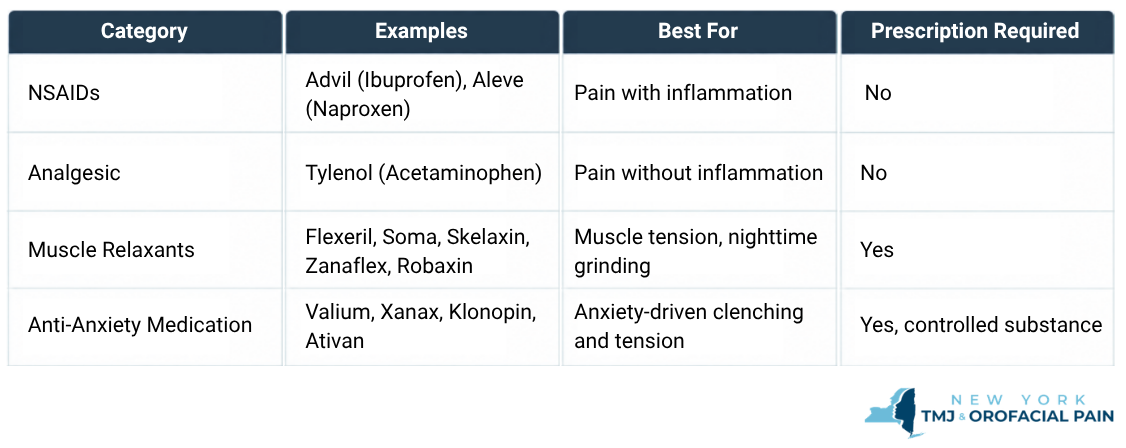
Four types of medication are commonly used for TMJ problems: NSAIDs like Advil and Aleve for pain with inflammation, Tylenol for pain without inflammation, muscle relaxants for tension and grinding, and anti-anxiety medication for stress-driven jaw clenching. Each works best for a short, specific period.
As a TMJ specialist, there are times when medications are an important part of the treatment strategy. Though side effects must be kept in mind, there are medications that are often extremely helpful for short periods of time. So, for many TMJ sufferers, I have found that there are some medications that work rather well to address pain, muscle tension, and jaw motion restrictions.
However, it’s the way that these medications are used that differentiates their effectiveness. The following information should be very helpful to those considering (or currently) taking medications for a TMJ problem.
Which Medications Reduce Pain and Inflammation from TMJ?
Advil (Ibuprophen) and Aleve (Naproxen)
Advil and Aleve are not muscle relaxants, despite common belief. They are non-steroidal anti-inflammatory drugs designed to reduce inflammation in joints and muscles.
For long-standing jaw problems, these medications must be taken for 2 to 4 weeks to be maximally beneficial, and the factors that caused the inflammation must also be addressed.
For some TMJ-specific inflammatory problems, these medications may be needed for 8 to 12 weeks, similar to the duration required for inflamed, painful knees.
Because Advil and Aleve can upset the stomach and kidneys, care must be taken with extended use.
Aleve has recently been recommended as the anti-inflammatory of choice for those at risk for a heart attack or with a history of heart problems.
Which Medication Relieves TMJ Pain Without Inflammation?
Tylenol (Acetaminophen)
Acetaminophen is a different class of drug than Advil and Aleve and is not an anti-inflammatory medication. It is an analgesic that is effective to relieve pain when inflammation is not present. Your doctor must monitor long-term use of Acetaminophen as it can induce headaches and can compromise liver function (particularly in individuals that consume alcohol daily).
What Muscle Relaxants Are Used for TMJ?
Muscle Relaxants
Commonly used muscle relaxants include Flexeril, Soma, Skelaxin, Zanaflex, and Robaxin, available by prescription only.
Muscle relaxants can be used during the day and at night before bed. Because some people feel fatigued using them during the day, several types may need to be tried to find the right fit.
Muscle relaxants can be combined with products such as Aleve, Advil, and other prescription anti-inflammatory options.
The time frame for use varies but can extend to many months, particularly when taken only at bedtime.
An added benefit is that muscle relaxants promote restful sleep and can reduce the intensity of nighttime grinding and clenching
When Are Anti-Anxiety Medications Used for TMJ?
Anti-Anxiety Medication
When anxiety and worry are driving muscle tension and pain in the face and jaw it is not uncommon to prescribe small doses of anti-anxiety medications for a short period of time to be taken during the day, at bedtime, or both. These medications work in the brain and help reduce the ability of muscles to “brace” as a consequence of life events, thoughts, and or emotions.
The commonly known medications in this category are Valium, Xanax, Klonopin, and Ativan. These are controlled substances, available by prescription only, and registered in a national data bank to help prevent overuse and abuse.
When taken at bedtime they are very effective (in short term periods) in reducing tooth grinding and clenching and the consequent symptoms of pain and muscle tension in the morning. My patients often report that anti-anxiety medication “takes the edge off my pain and muscle tension.”
So, for TMJ sufferers, medications have proven to be very helpful in breaking the “pain cycle” and allowing other therapies to begin to work for long-term relief. The key is using the right one, careful monitoring, and short-term use.
ARE YOU EXPERIENCING JAW PAIN OR OROFACIAL PAIN IN THE NYC METROPOLITAN AREA?
If you’re in the New York City metropolitan area and you’ve been dealing with jaw pain that hasn’t improved with standard treatment, you deserve answers, not just temporary relief.
At New York TMJ & Orofacial Pain, we specialize exclusively in diagnosing and treating TMJ disorders and orofacial pain. We take time to identify the true cause of your symptoms and build a treatment plan that directly addresses it, including coordinating with your physician when a medical condition may be contributing to your pain.
We have 4 locations: Midtown Manhattan, White Plains, Hauppauge, and Springfield, NJ.
CONTACT US TODAY TO SCHEDULE A COMPREHENSIVE EVALUATION. →About the Author
Dr. Donald R. Tanenbaum is a board-certified specialist who has dedicated his 40-year career to diagnosing and treating Orofacial Pain, TMD/TMJ, headache, and sleep-related breathing disorders. He practices in our Manhattan and Hauppauge offices.
What to Expect at Your First Visit →
Frequently Asked Questions About Medications for TMJ Problems
What medications are commonly used to treat TMJ problems?
The main categories are NSAIDs like Advil and Aleve, acetaminophen (Tylenol), prescription muscle relaxants, and anti-anxiety medication, each used for a different type of TMJ symptom.
Is ibuprofen or acetaminophen better for TMJ pain?
Ibuprofen and naproxen work best when inflammation is present, since they are anti-inflammatory drugs. Acetaminophen is a better choice for pain relief when inflammation is not a factor.
How long do NSAIDs need to be taken for TMJ inflammation?
For long-standing jaw problems, NSAIDs typically need to be taken for 2 to 4 weeks to be effective, and sometimes 8 to 12 weeks for joint-specific inflammation.
Are muscle relaxants safe for TMJ treatment?
Muscle relaxants are available by prescription and are commonly used for TMJ-related tension, though some people experience daytime fatigue, so a doctor may need to try more than one type.
Can anti-anxiety medication help with jaw clenching?
Yes. When anxiety drives muscle tension, small doses of anti-anxiety medication taken at bedtime can reduce nighttime grinding, clenching, and related morning pain.
Where can I get help managing TMJ medication in NYC, Long Island, Westchester, or New Jersey?
New York TMJ & Orofacial Pain sees patients at offices in Midtown Manhattan, White Plains, Hauppauge, and Springfield, NJ, and can build a full treatment plan around any medications you’re taking.

9 comments on “4 Medications For TMJ Problems”
I am a resident of Georgia, and I have seen three different Neuromusclar – dentists. I have my fourth set of splints, and I still have no success with managing my clenching behaviors at night. Do you have an suggestions for dentist in Georgia? I use neruomusclar massage therapy and chiropractors weekly.
Hi Selena,
I’m sorry to hear of your troubles. Here’s what I suggest: go to the website of the American Academy of Orofacial Pain and search the directory for a DIPLOMATE in your state. Hope you get some relief soon.
Dr. Tanenbaum
I have been experiencing TMJ and severe right ear pain for 2 months with severe ear ringing. I have been to my M.D. to two oral surgeons, and an ENT. I had a severe head trauma 14yrs ago but have never really experienced these painful symptoms. The oral surgeon diagnosed mis-aligned jaw and DMD, and wants to charge a fortune for orthotics. My M.D. says I should wait and take meds to try to resolve issue, she wanted to order MRI and I cannot have that because I have an pain stimulator in my body. She is ordering an Brain scan because I have so much pain in my right ear. I fear a tumor or another underlying issues. She believes since it started 2 month ago there was a trigger and believes bruxism the issue and stress related. I have read online about TMD, as well as tinnitus. I feel so confused and dis-oriented. Can you provide recommendations or advice. I reside in Florida and do not feel I am getting best possible medical advice.
Hi Mariza, Tinnitus may be related to your jaw and neck muscles if they are hyperactive.If tinnitus changes with jaw function and/or head positional changes, then there may be a relationship. Otherwise it will be unclear. Before you make any decision, go to the AAOP.org website and look for diplomate who practices near you. Make sure it’s a doctor designated as a diplomate.
I wish you luck and hope you start feeling better soon.
Dr. T.
Dear Dr. Tanenbaum,
Thank you for your informative article on medications for TMJ pain. I have severe episodic pain on the right side of my face, from my jaw to my temple,, apparently due to a mildly dislocated TMJ. I had moderate jaw pain a couple of years ago and it eventually went away after I started wearing a night guard . This time I’ve had the pain off and on for nearly a year, despite continuing to wear the night guard. Lately the pain has become severe. During the day,I take Advil, SAM-e, and hemp oil, and .at night before bed I take 50-100 mg of Trazadone and sometimes .25-..5 mg of Xanax. Even then, I can usually only sleep 4 hours at most before the pain wakes me up.
My dentist referred me to an oral surgeon and an orthodontist who specializes in TMJ disorder. The oral surgeon put me on Meloxicam and Orphenadrine, Meloxicam seemed less effective than Advil so I dropped it, and I stopped Orphenadrine after it caused extreme dry mouth.
The orthodontist wants to fit me with an Alf oral device that will cost, $10,000-$12,000, when all is said and done. Very little of it will be reimbursed by insurance.
Her are my questions:
1. How do you feel about oral devices, such as the Alf.? The National Institute of Dental and Craniofacial Research,, as well as the TMJ disorder website, strongly warn agains “treatments that cause permanent changes in the bite or jaw. So apart from the out-of-pocket cost of such devices, I wonder about the wisdom of installing something in my mouth that’s going to move things around and, I assume, change my bite.
2. The oral surgeon has suggested Botox as the next possible step . But the reviews on Botox for TMJ disorder are mixed. The rate of success seems to be in the %50%-60% range and there are risks of permanent muscle and nerve damage. Do you have an opinion on the use of Botox for TMJ disorder?
3. Finally, some dentists prescribe Tricyclic antidepressants for TMJ pain. What do you think? Is it something worth trying, in your opinion?
Thanks very much for any thoughts or suggestions you might have.
Donald A. Ranard
Arlington, VA
Hi, I have been suffering with tmd since high school off and on. I’m now hitting 40. I have broken several teeth from grinding, not to the point others can tell but I can definitely cut my tounge on my teeth and spit out pieces of tooth. I have many in extremely bad shape, the denten is exposed on most. I brux day and night. Jaw hurts all the time. Teeth and gums too, I’m miserable and it’s affecting my daily life which is also affecting my kids. I reside in NC and tried a dentist locally that went really bad. Started with a cleaning and c/u. Jaw locked the next day. Got a night guard and it helped at first but now doesn’t feel right and hurts (this was 6 months ago). Now I’m searching for help and don’t know who I should make an appointment with, as in what field. Btw I have tried prescription strength magnesium these 6 months and it hasn’t helped. Please, who should I see that can fix the damaged teeth and treat the tmd/bruxism? Any advice is sooo welcomed. I’m to the point that I’m willing to travel out of town for someone who can help me.
Hi There,
Sorry to hear of your troubles. Here’s what you should do…go to this website: http://www.aaop.org. That’s the American Academy of Orofacial Pain. Find a doctor in your area who is listed as DIPLOMATE.
I hope you feel better!
Dr. T.
I have suffered long term from tmj, chiropractor and acupuncture most effective. Also take 5mg baclofen at night or if really painful, take ibuprofen or naproxen. Conciously relaxing jaw, ice, massaging facial muscles a must. Hope this helps someone.
Hello,
i have a TMJ jaw locking issue. It started sometime back. I am using night guard however often one side of my jaw gets very tight and i am not able to fully open my mouth for food etc. I do not have any pain.
I do hot compress, wear night guard and also working on my habit consciously like biting my gums of cheeks.
How to open my jaw fully ?
Thanks